
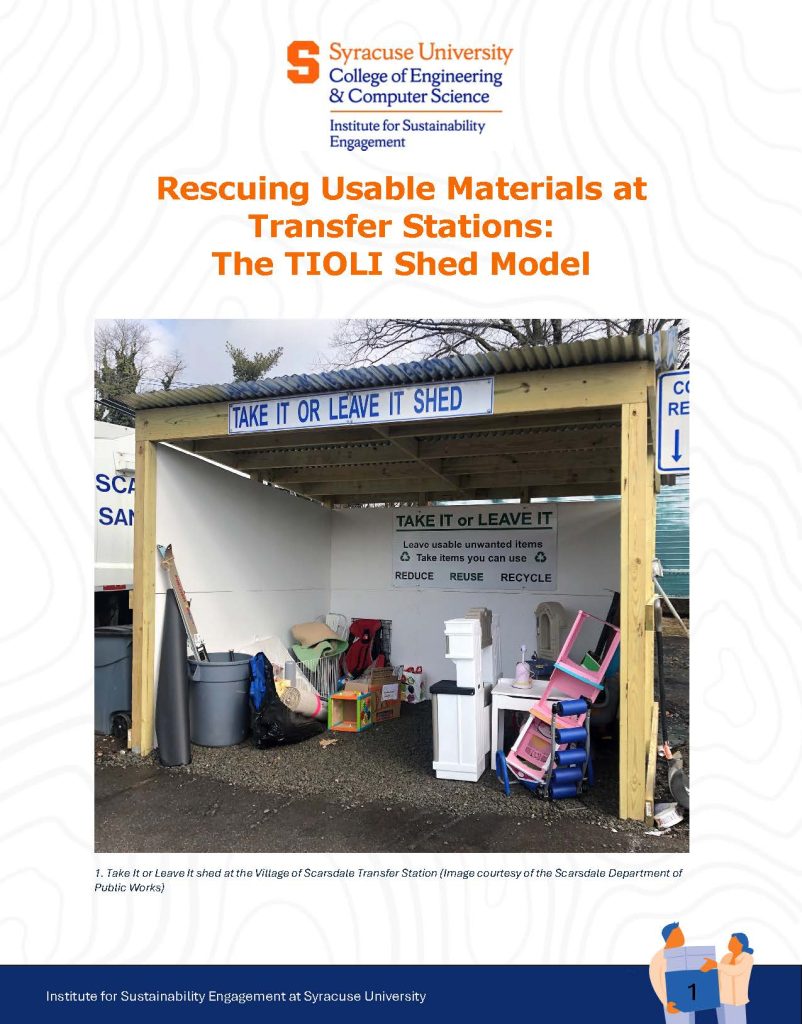
This resource was developed by the Institute for Sustainability Engagement (ISE) at Syracuse University. ISE provides no-cost support to communities across NYS and beyond to help them address challenges with solid waste management through the implementation of sustainable materials management (SMM) solutions (i.e., “waste” reduction, reuse, and recycling).
The contents of this article exist in PDF form, slightly edited. To view/download the PDF, click the link to the right (on desktop) in the “downloads” panel, or click the image above.
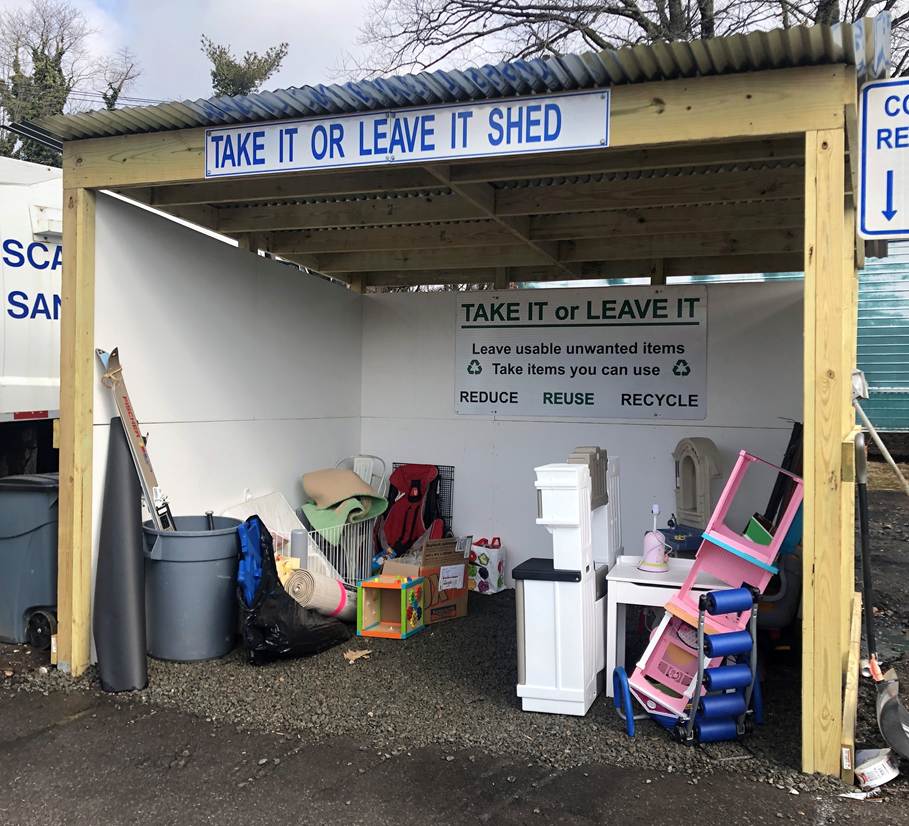
What are TIOLI Sheds?
Take It Or Leave It (TIOLI) sheds are small, dedicated structures or spaces where community members can donate or take household goods (e.g., cookware, appliances, toys) for free. These spaces help to keep usable materials out of the waste stream and recirculate them in the community, providing both environmental and social benefits. Some examples of TIOLI sheds in New York State include:
- City of White Plains TIOLI Shed
- Town of Bedford TIOLI Shed
- New Castle TIOLI Shed
- Scarsdale TIOLI Shed
TIOLI sheds help to prevent the premature disposal of usable household goods, which can reduce the costs of disposal for municipalities, conserve landfill space and natural resources, save residents money on needed household items, bring community members together, and help achieve sustainability goals.
This document aims to provide clarity around the common challenges of implementing a TIOLI shed, including concerns around staffing, physical space, funding, permitting, and liability, using information from TIOLI shed managers throughout New York State.
Commonly Accepted and Unaccepted Items
Because of the small scale of most TIOLI Sheds, there are commonly accepted and unaccepted items, though individual transfer stations vary. Accepted items are typically required to be in good condition, clean, and functional. Items that are broken, damaged, or dirty are typically unacceptable. For items that are not accepted but still in usable condition, transfer station staff may consider directing residents to local thrift stores/reuse centers, other drop-off locations, or digital marketplaces (e.g., Facebook Marketplace).
| Commonly Accepted Items: -Cookware and dishware -Decorations -Toys, games, and puzzles -Some baby and children’s items -Office and school supplies -Tools and home repair items -Small kitchen or household appliances (e.g., lamps, blenders, vacuums) | Commonly Unaccepted Items: -Electronics such as computers and TVs -Large furniture -Mattresses -Most textiles (e.g., clothing, bedding, pillows, stuffed animals, rugs) -Large appliances (e.g., refrigerators) -Car seats, strollers, highchairs, and cribs |
Acceptable and unacceptable items vary by location based on space and capacity of the transfer station. Other items such as bicycles, small furniture, sports equipment, books, garden supplies, small electronics, and building materials are usually decided on an individual basis. Some facilities partner with reuse/repair organizations to take excess, damaged, or unaccepted items as well.
Strategic Benefits of Siting TIOLI Sheds at Transfer Stations
TIOLI sheds can be established at a variety of locations, but there are strategic benefits of siting them at transfer stations. Not only do transfer stations already have facilities and staff present, but they are also the last opportunity for reuse before materials are sent to disposal or recycling facilities.
Since community members already drop unwanted materials at these locations, there is also community recognition of the space and location. In fact, it is common for other types of reuse to already exist at transfer stations (e.g., clothing/textile donation bins, furniture donation corners, mattress recycling, free book libraries). Some municipalities have TIOLI sheds at their Recycling Centers, which can provide similar benefits if residents use these facilities regularly.
Physical Space
Some transfer stations dedicate a specific corner or area of the transfer station for staging reusable items, which reduces the costs of obtaining new infrastructure. Another low-cost option is to reuse existing structures/materials for a TIOLI shed. The TIOLI shed in White Plains, NY was constructed using side-by-side shipping containers.
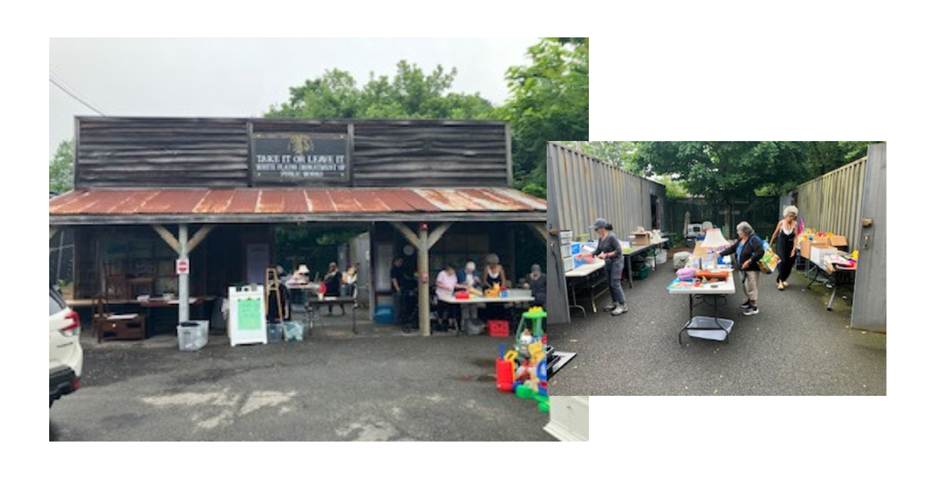
In Scarsdale, NY, an old bus stop overhang was converted into a TIOLI space. Other municipalities received funding through other mechanisms such as grants, fundraisers, or drop-off fees to secure a stand-alone shed or a robust TIOLI space.
Staffing
Even though transfer stations have their own staff, many do not have the capacity to completely monitor a TIOLI shed. Because of this, TIOLI sheds are often run by a group of volunteers who coordinate item drop-offs and pick-ups on specific days/times. The volunteers ensure the quality and eligibility of donated items and enforce visitor rules (e.g., item or time limits per guest, residence verification). Volunteers can also ensure that items are well-displayed so they are easily visible to residents. Clear rules, expectations, and communication can help alleviate potential friction between volunteers.
➜ Tips for Volunteer-Based Staffing
- Potential volunteers: retirees, environmental clubs/organizations, community service groups, students looking for community service hours, TIOLI shed visitors
- Use communication and scheduling platforms that work for everyone (e.g., SignUp Genius may be good for organizing volunteers, but can ostracize folks with limited technology skills)
- Make sure volunteers are physically able to move items, especially if you accept bulky or heavy donations
- Consider having a dedicated volunteer coordinator to make TIOLI management easier for employees and other volunteers
- Show appreciation to all volunteers (e.g., verbal recognition, periodic celebrations, giveaways, free food/drink provided during shifts)
Some TIOLI sheds are self-serve, so residents can drop off items and pick up items freely during the transfer station’s hours of operation. Staff then check the shed regularly to ensure that only usable items are donated. For municipalities with the capacity, existing staff may be able to monitor donations and pick-ups during operational hours.
Funding
Many transfer stations are able to fund TIOLI spaces through their existing drop-off fees and material scrapping revenue (e.g., scrap metal). Funding from municipalities may also be available as TIOLIs contribute to sustainability goals, public services and community aid, and lower disposal costs long term. Philanthropic investments, like those from community foundations, are another potential funding source. If community partners are unable to fund a TIOLI themselves, crowdsourcing donations through fundraisers or by using platforms like GoFundMe is another option.
There are also statewide grants available for reuse projects like TIOLI sheds such as:
- NYSP2I Community Grants: Annual grants allowing local government agencies to apply for up to $20,000 to support community waste reduction projects.
- NYSAR3 Community Reuse Grant: Annual grants designed to support NYS communities implement reuse initiatives in their communities. A total of $15,000 is awarded per year ($1,000-$5,000 per awardee).
- NYSDEC Grants for Waste Reduction, Recycling And Household Hazardous Waste Programs:
- Climate Smart Community Grant Program: This program can help municipalities acquire funding for climate-smart materials management initiatives. (Establishing a permanent TIOLI shed at a transfer station or other municipal location counts as a ‘medium scale’ reuse program.)
Liability
Some municipalities have insurance for their entire facility that covers their TIOLI sheds. Though some insurance companies discourage reuse initiatives for liability reasons, some potential solutions are to provide inspections of items upon drop-off, waivers for those taking items, warning labels on items, and clear and thorough outreach to the community. The level of involvement the municipality has in the TIOLI may also influence the liability measures needed (e.g., if it is volunteer run versus staffed by the county/city/town).
Permitting
Since reuse is not waste, TIOLI sheds do not require a permit from the NYS Department of Environmental Conservation’s (DEC) Division of Materials Management, and counties do not need to go through any specific procedures with DEC’s Division of Materials Management to establish a TIOLI shed at a transfer station.
If you have any questions about the information in this document or establishing a TIOLI shed in your municipality, please contact ISE Project Assistant, Ivy Ven Roy, at idvenroy@syr.edu.
Funding Disclaimer: The development of this resource was supported with funding from the U.S. Department of Agriculture through a Solid Waste Management grant.
USDA’s Non-Discrimination Statement: In accordance with Federal civil rights law and U.S. Department of Agriculture (USDA) civil rights regulations and policies, USDA, its Mission Areas, agencies, staff offices, employees, and institutions participating in or administering USDA programs are prohibited from discriminating based on race, color, national origin, religion, sex, gender identity (including gender expression), sexual orientation, disability, age, marital status, family/parental status, income derived from a public assistance program, political beliefs, or reprisal or retaliation for prior civil rights activity, in any program or activity conducted or funded by USDA (not all bases apply to all programs). Remedies and complaint filing deadlines vary by program or incident. Program information may be made available in languages other than English. Persons with disabilities who require alternative means of communication to obtain program information (e.g., Braille, large print, audiotape, American Sign Language) should contact the responsible Mission Area, agency, or staff office; the USDA TARGET Center at (202) 720-2600 (voice and TTY); or the Federal Relay Service at (800) 877-8339.